
I. Why the electron must be singled out: it is not a side character, but one of the long-term foundations of the material world
In the structural narrative of Energy Filament Theory (EFT), the electron must be singled out not because it happens to rank near the top of the particle table, but because it carries three system-level responsibilities:
- First, it is one of the very few lock-state structures that can survive for the long haul, which lets it serve as a genuine building block in the repeated assembly of higher-level structures.
- Second, it is the archetypal particle that can write a Texture Slope: its structure leaves behind a road bias in the Energy Sea that can persist and superpose, so a huge range of micro- and macro-scale phenomena can be described in the same language of "slope and Channel."
- Third, it is the main carrier of atoms, chemistry, and electromagnetic phenomena: remove the electron, and matter loses its most common controllable way of coupling and its most stable form of hierarchical organization.
So the electron is not "a tiny negatively charged dot," but a composite of "self-sustaining structure + a Sea-State imprint it can stably write": stability comes from structural engineering conditions, attributes come from structural readouts, and macroscopic effects come from the averaging of large numbers of electron imprints.
II. The electron's minimal configuration: a closed Filament ring - why the ring form is required
In EFT's ontological language, the electron's first-principles shape is neither a point nor a tiny charged sphere. It is a Filament pulled taut and locked by the Energy Sea until it closes into a single ring. That point can therefore be stated as a hard axiom at the level of particle structure (Axiom 2): if a structure is to sustain itself for the long haul and carry repeatable attribute readouts, its minimal skeleton must eliminate endpoints and achieve Closure; for charged leptons, that minimal closed skeleton takes the concrete form of a single ring. The ring is not a pictorial metaphor but the lowest-cost topology by which a structure can sustain itself: as long as endpoints remain, the structure is more like an open Channel that can be torn and reconnected; only when the endpoints are eliminated, and geometry and phase can return to themselves after one full turn, does identity have a chance to lock in.
A common misunderstanding needs clearing up first: the electron is not "a little loop spinning wildly in space." A closer picture is that the ring itself is relatively stationary while energy and phase keep running around it, forming a stable circulatory Cadence. Readouts such as spin and magnetic moment come from this circulation geometry, not from the rigid-body rotation of a tiny hoop.
- No endpoints: endpoints are Gaps. The two ends of an open Filament segment are leakage ports for Tension and phase. Sea-State disturbances repeatedly "tear open - backfill - reconnect" at those ends, pushing the structure to degenerate either into a propagating disturbance or into fragmented, short-lived pieces. Once the loop closes, the endpoints disappear and the hardest Gap is erased; only then can the structure enter a repeatable self-consistent cycle.
- Phase closure: a closed loop turns "one full turn brings you back to yourself" into a hard constraint, so circumferential phase can occupy only a small set of allowed closure patterns. Continuous ways of winding are filtered into a discrete set of viable stable states, which is why some electron attributes show up as stable tiers instead of drifting around like stickers.
- Self-sustaining circulation: every measurable "clock" comes from a repeatable internal process. A closed ring provides a natural cyclic path, letting energy flow run self-consistently along one and the same route and thereby form an intrinsic Cadence. An open structure struggles to seal that Cadence inside itself; its rhythm is more easily dragged apart by the environment and dissipated at the endpoints.
- Long-term maintenance of electrical asymmetry: the electron's charge appearance comes from the net radial orientational Texture written by a cross-section that is "strong inward, weak outward" (or, equivalently, by an asymmetrical tightening). Only inside a closed ring can that asymmetry be locked together with circumferential continuity, so that a repeatable net bias survives even after far-field averaging. In an open segment, endpoint Backfilling and rearrangement erase that asymmetry much more easily.
- Being nearly point-like does not abolish the ring: the scale of the electron ring can be extremely small, so within existing experimental windows its scattering appearance may be approximately point-like. But "point-like appearance" is only an average outcome of the far field and short time windows; it does not mean the ontology lacks thickness or circumferential organization. EFT distinguishes visible appearance from structural ontology precisely so that approximation is not mistaken for axiom.
In structural-economic terms, the single ring is the smallest closed part: with the least internal organization, it can satisfy Closure, Self-Consistency, and readable attributes all at once. Once you add extra phase-lock conditions, submodes, or more complex decompositions of internal circulation, both the degrees of freedom and the exit Channels rise quickly, the Locking Window narrows, and lifetime becomes easier to shorten. That is the structural intuition behind the layered charged-lepton generations (electron versus μ/τ).
III. Why the electron can persist for the long haul: stability is not a gift, but the combined effect of a high Locking threshold and sparse Channels
Earlier in this volume, stable particles were not defined as names placed on a cosmic roster. They were defined as the rare structures in the Sea-State process of trial and selection that can cross the Locking threshold and remain self-consistent under long-term disturbance. The electron's long-lived existence can be compressed into two hard conditions:
- The Locking threshold is high enough: the electron's core structure can form a stable Closure, bringing internal circulation and the surrounding Sea State into a balance that partly repairs itself. An ordinary collision is not enough to deconstruct it back into the Sea.
- There are very few feasible exit Channels: under the same Sea State and the same conservation constraints, the electron has almost no alternative lock-state that is more ledger-efficient. In other words, the electron is not "incapable of change"; it is simply that change offers no ledger advantage. Most disturbances get absorbed as small adjustments of phase and Tension rather than triggering a rewrite of identity.
Together, those two points explain a paradox that only looks like a paradox: the electron couples strongly to the outside world - it participates in electromagnetic phenomena - yet it is extraordinarily hard to make it decay. The reason is that coupling strength decides whether the structure can be read and whether it can act; it does not directly decide whether the structure can be dismantled. Deconstruction has to satisfy much stricter threshold and Channel conditions.
IV. What "negative charge" means in EFT: not a label, but a repeatable Texture orientation
In EFT, charge is not an externally assigned quantum number. It is the Linear Striation orientational imprint that structure writes into the Energy Sea. What we call positive and negative are not symbols pasted on point particles, but two mirror organizations:
The electron biases Linear Striation toward an inward-converging road bias; the proton - or, more generally, outward-oriented structures - biases it toward an outward-splaying road bias. When the two are superposed, space develops a continuous slope from rougher to smoother. That is why outward appearances such as attraction and repulsion can be averaged and read as a Texture Slope.
Writing charge as Texture orientation has two immediate payoffs:
- First, it gives remote influence a materials meaning: the remote effect is not a mysterious line of force, but the extension of a road bias. A road bias can superpose, it can be rewritten by boundary conditions, and it can also be screened or guided.
- Second, it grounds positive-negative symmetry geometrically: a sign flip is not a change of label but a reversal of orientation. That is why later discussions of antiparticles, annihilation, and pair production can enter the framework of mirror structures naturally.
V. Why the electron can write a Texture Slope: its imprint is stiff enough and clean enough
Not every particle can write a slope that survives macroscopic averaging. Many short-lived structures either leave imprints that are too local - effective only inside near-field Interlocking - or imprints that are too messy, changing their spectrum too quickly in time to form a repeatable road map. The electron is special because its structural imprint satisfies three engineering conditions at once:
- Coherence: the electron's Linear Striation orientation stays consistent across a substantial range of scales instead of flipping randomly on short timescales.
- Superposability: the imprints of large numbers of electrons can be superposed statistically into a usable "slope surface." That is what lets electromagnetic phenomena move from the structural readout of a single particle to a field-style reading of a many-body system.
- Controllability: electrons can be confined by boundaries and structures - atoms, molecules, conductors, cavities - and their imprints then rearrange themselves predictably under those boundary conditions. Macroscopic engineering can control electromagnetic effects because what it really controls is the way electron ensembles organize their imprints.
Put differently, the electron is not the entity that "creates a field." It is the most common Texture writer. Once the spatially averaged result of that writing is read in continuous language, it appears as a "field." This volume fixes only the microscopic semantics: electron structure can stably write roads, and that is why the world has a repeatable electromagnetic road system.
VI. Why spin and magnetic moment are especially "clean" on the electron: internal circulation as a repeatable geometric readout
In EFT, spin and magnetic moment are not mysterious quantum numbers but readouts of internal circulation and phase-locking inside a lock-state. The electron's spin and magnetic moment look so "standard" - and have become the yardstick for so many experiments - because its internal circulation structure is relatively simple and stable:
It is simple enough that the set of viable stable states is small, so the readout falls into clear discrete tiers. And it is stable enough that under external disturbance it tends to keep the tier while shifting phase, rather than rewriting itself into a different structural family.
That also explains why the electron is so often treated as the archetypal microscopic gyroscope: it can undergo orientational selection inside an external Texture Slope - which shows up as the outward appearance of magnetic interaction - yet the selection process itself does not readily tear the structure apart.
The discreteness of spin readout, in EFT, does not require an axiom of "innate quantization." It follows from the fact that only a small number of circulation geometries can sustain themselves repeatably. When this book later turns to measurement and statistical readout, it will show how experiments force that discrete splitting into the open as a consequence of the Rule Layer and threshold devices.
VII. The electron and the atom: from "wanting to slide downward" to "being able to occupy a position" - the orbital is a Channel, not a trajectory
When an electron encounters an atomic nucleus - more generally, any structure with a positive orientation bias - the first thing it meets is a Linear Striation slope. The road bias pulls the electron toward the smoother direction, which at macroscopic scale is read as attraction. If that were the only slope in play, the electron would indeed keep sliding and collapse into the nucleus.
What changes the outcome is that the electron's own circulation, together with the nucleus's near-field organization, creates outside the nucleus a repeatable set of Swirl-Texture and Cadence windows. Linear Striation supplies the direction of approach; Swirl Texture supplies the stability threshold once the electron comes close; Cadence supplies the allowed tiers. The electron therefore does not end up on a little track orbiting the nucleus. It is forced to stand inside a small set of Corridors that can remain self-consistent for the long haul.
So in EFT, the orbital is first of all a structural term: it names the spatial projection of a set of allowed-state Channels, not the classical route of a little ball. This wording will carry through all later deductions about atoms, molecules, and materials.
VIII. Why the electron is the main agent of chemistry: it can be bound, yet can also share Corridors between structures
Chemistry is possible, at bottom, because there exists a kind of particle that:
- can remain in existence for the long haul without tearing the whole structural machine apart;
- can be confined by boundaries, so repeatable hierarchical structures can form;
- and can open cooperative Channels between multiple centers, linking structural components into networks.
The electron satisfies exactly that set of conditions. In EFT language, it is well suited to the role of a "Corridor resident." Atomic nuclei provide the boundaries of the road network and the local Cadence, while electrons establish resident Channels within it. When two or more nuclei come close, the road network gets spliced and rearranged, and the electron's Corridors shift accordingly from single-nucleus Channels into shared multi-nucleus Channels. In outward appearance, that is a chemical bond.
Within this framework, the differences among covalent bonds, ionic bonds, metallic bonds, and the like do not have to start from abstract potential-energy curves. They can be understood as different modes of Texture coupling and different geometries of Corridor sharing.
IX. Why matter does not collapse: electrons cannot overlap in the same form - a hard constraint, not a soft repulsion
Even once orbital Corridors and chemical bonds exist, matter still faces a harder question: why do a large number of electrons not all crowd into the single Corridor with the cheapest ledger cost and make structure collapse?
In mainstream narratives, that burden is carried by Pauli exclusion and Fermi statistics. EFT takes it over by rewriting it as a structural constraint: the same class of lock-state structure, under the same boundary conditions, cannot overlap and occupy in a completely identical form. The so-called "repulsion" is not an extra force added on top; it is the geometric limitation built into the set of allowed states.
That hard constraint is the common baseplate of the periodic table, material hardness, bulk elasticity, and macroscopic stability. Here the point can be stated simply: the electron not only provides "adhesive Corridors," it also provides "rules of occupancy." These details belong to the discussion of quantum statistics and the hard mechanics of orbitals.
X. The electron's "testable structural profile": what becomes easier to understand if we treat it as a structure
Once the electron is treated as a structure rather than a point, three classes of phenomena become immediately more natural:
- Why the electron can both participate in long-range interaction and preserve extraordinarily high stability: because writing roads and deconstruction are controlled by two different thresholds.
- Why orbitals are discrete and keep stable shapes: because the set of self-consistent Corridors that can actually stand is finite, rather than every radius in space being equally occupiable.
- Why "spin" can function as a repeatable readout and enter magnetic phenomena: because the set of viable stable states of internal circulation geometry is finite, and the readout apparatus merely selects and amplifies those stable readouts.
In EFT, these phenomena are not explained separately. They are three projections of the same structural language: stability, road-writing, and occupancy.
XI. The electron is a beam: it links microscopic lock states to the repeatable structures of the macroscopic world
The electron's status as a stable building block comes from its simultaneous possession of three abilities: it can sustain itself (it stays locked), write roads (its imprint endures), and occupy positions (the rule is hard-constrained).
Starting from the electron, we can rewrite not only attributes such as charge and spin from stickers into structural readouts, but also atomic orbitals, chemical bonds, and material stability as different stages along one and the same chain of assembly.
Once that chain is in place, later volumes can discuss fields and forces, light and Wave Packets, quantum statistics, and measurement without falling back into the hanging narrative of "point particles + abstract equations." The discussion can remain anchored in testable structure and the semantics of Sea State.
XII. Electron structural schematic (Figure 1 shows the electron, Figure 2 the positron)
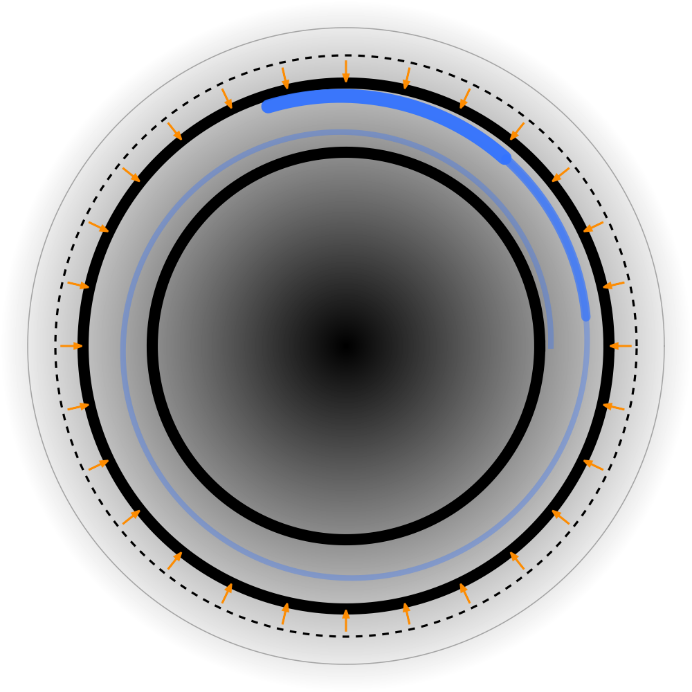
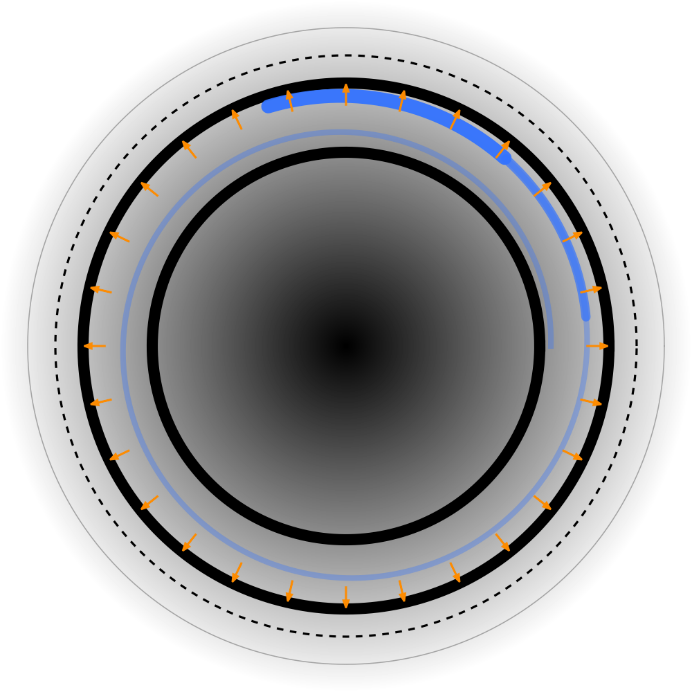
- Main body and thickness
- Closed single ring with a Filament core: the same Energy Filament closes into a ring; the double outline in the figure indicates only a self-sustaining ring with thickness, not two separate Filaments.
- Equivalent circulation / ring-like flux: the magnetic moment comes from the contribution of equivalent circulation and does not depend on an observable geometric radius (the schematic does not depict the main ring as a "current loop").
- Phase Cadence (not a trajectory; shown inside the ring as a blue spiral)
- Blue spiral phase front: the blue spiral between the inner and outer rings marks the "phase front at this moment" and the phase-locking Cadence.
- Fading tail -> stronger leading front: the tail is thin and light, the leading front thick and dark, expressing chirality and the direction of time; this is not a particle trajectory, only a marker of Cadence position.
- Near-field orientational Texture (defines charge polarity)
- Small radial orange arrows: a ring of short orange arrows outside the ring points radially inward, indicating the near-field orientational Texture of "negative charge"; microscopically, motion along the arrow direction encounters less hindrance and the reverse direction more, which gives rise to attraction/repulsion.
- Positron mirror image: in the positron figure, the small arrows point radially outward and the overall response sign is mirrored.
- Mid-field "transition cushion"
- Soft dashed ring: it marks the transition layer that smooths out near-field detail; it suggests how the anisotropic near field is progressively washed smooth by time averaging.
- Far-field "symmetric shallow basin"
- Concentric gradient / contour rings: a concentric light-to-dark gradient and fine dashed contour rings represent the axisymmetric pull of the far field - the steady outward appearance of mass - with no fixed dipolar bias.
- Figure elements
- Blue spiral phase front (inside the ring)
- Direction of the near-field radial arrows
- Outer edge of the transition-cushion layer
- Basin aperture and contour rings
- Reader note
- The "running of the phase band" is the migration of a mode front; it does not represent superluminal motion of matter or information.
- The far-field appearance is isotropic, consistent with the equivalence principle and existing observations; within current energy ranges and time windows, the form factor must converge to a point-like appearance.
XIII. Electron artwork (intuition aid)

Stability intuition: the electron's stability does not depend on rigid-body self-rotation. It comes from the phase front and equivalent circulation on a closed single ring continuously maintaining the lock-state; local Tension and Cadence are kept inside the self-sustaining window, so small disturbances do not easily tear it open or backfill it.

Like-charge repulsion intuition: when like-charged electrons meet, their inward-oriented Texture forms a counterflow blockage in the overlap region, raising the organizational cost; the system separates along the more ledger-efficient direction, which macroscopically reads as repulsion between like charges.