
I. Quarks are not "free-particle nouns," but the internal structural grammar of hadrons
In Energy Filament Theory (EFT), a "particle" is not, first of all, a noun listed in a table. It is a Locked Structure in the Energy Sea that can sustain itself, recur, and be read out statistically. If some object cannot remain independently present for the long haul once it is removed from environmental support, then writing it as a "free particle" dead-ends the problem from the start: all one can do is wrap it in slogans such as confinement, invisibility, or appearance only through virtual processes, without saying what it actually is, why it can appear only in composite form, or where its labels come from.
Quarks sit exactly at that point. Experiment tells us that hadrons - mesons, baryons, and their many resonance states - are visible, and that what falls out at the ends of jets is likewise a string of hadronic fragments. But to "pull out one quark by itself" is macroscopically impossible. Mainstream theory describes that fact by saying that quarks are basic particles confined by a gauge field. EFT states the same fact more directly: a quark is not a member of the roster of free particles, but a structural unit - or structural port - inside hadrons, and the various quantum-number labels attached to it are, in essence, encodings of the feasible configurations available inside hadronic structure.
This section begins with structural semantics rather than a full retelling of the Strong Interaction. In EFT, quark / color / flavor / generation form the language that tells us how hadrons close, how they remain stable, and why such a rich hadronic lineage can appear. Without that groundwork, later discussion of gluon Wave Packets and Strong-Interaction rules would slide back into the old narrative of "quantum-number stickers + little exchange balls."
II. The minimal structural picture: a Filament core + a color Channel (bringing "color" back to the engineering port)
Within the overall framework that rewrites particles as structures and properties as readouts, the minimal image of a quark is not a point with no size, but an unclosed unit. In a more intuitive picture, one may first think of it as the smallest and most unstable little Filament ring. More strictly, it is better written as "a Filament core + a color Channel port." Those two ways of speaking do not conflict. The former stresses that a quark is not a point but has a closed inner core. The latter stresses what really separates it from the electron: not merely that it is also ring-like, but that this inner core has not balanced the near-field ledger.
This stands in exact contrast to the electron in Section 2.16. The electron is a long-lived self-sustaining closed single ring: its circumferential organization can remain stable and continuous, while its cross-section retains a repeatable radial orientational bias, allowing the outward appearance of positive or negative charge to be written into the near field for the long haul. A quark can also be traced back to a smaller closed inner core, but its near-field Tension and Texture are visibly biased toward one side. As a single unit, it cannot converge its orientational readout mainly into "radial electricality" the way the electron does. It naturally leaves behind an unsealed bias port.
That unsealed bias port is not a side effect. It is the structural root of "color." Once the Filament core is biased toward one side, the Energy Sea is pulled along that side into a narrow corridor of high Tension and strong orientation - the color Channel, also often called the color flux tube or color bridge. It is not a second real Filament and not an extra external field pasted onto the object. It is a Tension corridor drawn out in the Sea State by the quark's asymmetric near field: where the region is tighter, where passage is less obstructed, and where docking with another partner must occur are all written into that Channel.
The minimal difference between electron and quark can therefore be summarized simply: the electron locks its main outward appearance into a long-lived radial orientational Texture, whereas the quark turns the unbalanced part of its Tension and Texture outward as a color Channel port. For that same reason, a quark is not unstable because it "lacks some external field that protects it." It is unstable because, as an unclosed structure, its ledger does not close in the first place. Unless a single quark completes complementary docking with another quark or an antiquark, that color corridor cannot be sealed.
III. Color: three mutually exchangeable Channel orientations, not labels pasted onto a point
What mainstream language calls "color charge" corresponds in EFT to classes of color-Channel orientation. The same Filament-core port can activate three distinct yet mutually exchangeable high-Tension Channels inside the Energy Sea. Calling them the "three colors" is simply a convenient index for those three Channels. They are not three pigments, but three distinguishable directions of a structural port.
Seen this way, three facts that can seem abstract, yet appear throughout the hadronic world, fall back onto structure:
- The "three colors" are not mysterious quantum numbers, but a discrete classification of three Channels: at a given scale and under a given Sea State, the Energy Sea permits three stable orientational corridors and allows them to be exchanged with one another in interaction.
- "Anticolor" is not an extra sticker, but the mirror or reversal of a port orientation: when the orientation of a Filament-core port flips, the corresponding Channel responds in the complementary way, allowing the two ends to form a closable whole.
- "Color exchange" is not little balls passing force from hand to hand, but a redistribution of Channel occupancy: in a multi-port structure, which Channel carries the Tension inventory and which carries the phase Locking can be continually rewritten by internal Wave-Packet disturbances, so outwardly the "color" appears to change.
Within this semantics, "color conservation" does not need to be written into the theory first as an axiom and then retroactively explained as something nature happens to obey. It follows from a hard requirement of closure: the net orientation of the Channel ports cannot leave an unsealed defect in the far field, or else the ledger does not close and the structure cannot sustain itself for the long haul. What "overall colorless" means is simply that the structure can seal in the far field: either the composite readout of the three Channel orientations sums to zero, or complementary docking removes the exposed high-Tension corridor from the far field altogether.
IV. Confinement: why no one sees an "isolated quark," and why "the farther you pull, the tighter it gets" is a necessary appearance
Once "color" is understood as a Channel port, confinement stops being a mysterious rule and becomes a materials fact: one cannot let a narrow corridor of high Tension and strong orientation extend through the Energy Sea without paying an ever-rising cost. For a quark, "pulling it apart" does not mean separating two little balls. It means stretching and thinning the color Channel between them, so that the high-cost region extends over a larger scale.
In that picture, "the farther you pull, the tighter it gets" is almost a necessary appearance. The per-unit-length Tension cost of the color Channel stays within a certain range, so once the Channel is lengthened, the total cost climbs rapidly with length. Pulling harder does not hand you a free quark. It pushes the system toward a more economical settlement: the Energy Sea triggers relinking and nucleation in the middle of the Channel, creates a complementary quark-antiquark pair, and cuts one long Channel into two shorter ones, each of which closes into a new hadron.
From the topology of closure, when two complementary ports dock, they form a binary closure: the meson. When three complementary corridors merge locally at the most ledger-economical geometry, they meet at a Y-shaped node: the baryon. Whether the closure is binary or ternary, the essence is the same: the unbalanced asymmetry carried by each individual quark is drawn back into the near field, so that the far field no longer exposes a color corridor. The jets and hadronization seen in experiment are precisely this process. High energy drives long Channels to criticality, and the system keeps breaking a "long crack" back down into these "short closures." What reaches the detector is not an isolated quark, but a shower of mesons together with a smaller number of baryons.
The complementary appearance of confinement, asymptotic freedom, also emerges naturally within the same structural picture. When several quark cores are squeezed onto extremely short scales and brought very close together, the Linear Striation of the direct corridors and the internal Swirl Texture organization overlap strongly and partially cancel, producing a microcavity with nearly flat Tension. Inside that microcavity, relative motion among quarks does not require further lengthening of the binding band and does not incur a major Sea-State rearrangement cost. Outwardly, the appearance becomes "the closer they are, the freer they look."
V. Flavor: the family names of winding order and phase-lock mode (an intuition for mass, lifetime, and the tendency to fall back down)
If color answers "how do the ports close, and why must they close," then flavor answers "what winding mode does the Filament core take on inside." In EFT, the up, down, strange, charm, bottom, and top "flavors" can be understood as differences in the winding order and phase-lock mode of the Filament core. They are all local winding knots, but their internal phase skeletons, circulation decompositions, and ways of coupling to the color Channel differ, and those differences show up as layered readouts of mass and lifetime.
This interpretation has one major advantage: it rewrites the quark mass spectrum from a pure parameter table into a table of structural cost. A Filament core with higher winding order and a more complex phase-lock mode requires a larger self-sustaining ledger. At the same time, it usually has more exit Channels that can be triggered, which shortens its lifetime. Intuitively, it comes down to two sentences:
- The higher the order of the mode, the larger the self-sustaining cost, and so the heavier the readout.
- The higher the order of the mode, the closer it lies to the edge of the window and the more viable Channels it has, so it is shorter-lived and more prone to fall back down to a lower-order state.
This also yields a natural explanatory framework for why heavy-flavor quarks usually appear only briefly in high-energy processes; why many hadrons containing strange, charm, or bottom quarks show up as resonance states; and why the top quark exits so quickly that it often fails to make it to the step of closing into a hadron - which is why observation gives it the special outward appearance of being "read out almost directly as a quark." None of this requires flavor to be treated as a mysterious sticker pasted onto a point. It can be treated instead as a lineage index of phase-lock modes.
VI. Generations: layered windows and the batch-wise opening of the "stable structural set"
Once leptons have been written as a layered structure in which the electron is stable while mu and tau are short-lived, the quark "generations" stop being arbitrary groupings as well. They become the same logic expressed inside the hadronic world: the Locking Window provided by the Energy Sea is not one continuous threshold that treats all modes equally, but a layered set of feasible regions. Filament cores with different winding orders and different phase-lock modes are allowed to exist as recognizable units only when specific Sea States and boundary conditions are met.
Accordingly, the three quark generations can be read as three batches of feasible modes: the first generation - up and down - corresponds to the most ledger-economical modes and the ones that can most easily participate for the long haul in hadronic structure under today's Sea State. The second and third generations - strange and charm, bottom and top - correspond to higher-order modes that sit closer to the edge. They depend much more heavily on local high-energy events to push the Sea State into a narrow window, and so they are shorter-lived and look more like temporarily stable shells near criticality.
The point is not to spell out the detailed winding pattern of every flavor, but to establish a criterion: generational differences are not "a change of ID card," but the combined consequence of three things - higher phase-lock order, a narrower window, and a larger number of Channels. That rewrites the question "why does nature have three generations?" from a mysterious fact into a structural-engineering problem that can actually be pursued: which Sea-State knobs determine the layering of the windows, and which boundary conditions can briefly hold up higher-order modes? Once those questions are stated clearly, the theory begins to move from description toward testability.
VII. From labels to a lineage: how color and flavor help us read the hadronic world
If quarks are the structural grammar inside hadrons, then color and flavor are no longer isolated quantum numbers, but two complementary kinds of information: color tells us how the ports close, while flavor tells us what mode the Filament core is in. The hadronic lineage is so large not because nature invented countless additional elementary particles, but because the combination space of Filament-core mode x port-closure pattern x critical margin can generate an enormous variety of temporarily stable structures.
Seen from that angle, familiar hadronic classifications acquire a far more intuitive structural meaning. Mesons correspond to binary closures formed by complementary docking of ports. Baryons correspond to the local closure of three ports in the most economical way, often as a Y-shaped convergence rather than a simple triangular perimeter. Large numbers of resonance states correspond to critical structures in which closure has already been achieved, but the margin is small, the shell is thin, and disturbances can easily punch through it.
This also explains why memorizing the hadronic world as a "particle table" quickly stops working: one cannot remember all the names because the names do not stand for independent ontologies. They are branches and leaves generated by one and the same structural grammar. A more workable method is this: first use color to identify the closure skeleton, then use flavor to specify the Filament-core mode, and finally use the margin of the Locking Window to judge whether the result is closer to a stable nucleon, a short-lived hadron, or a transient resonance.
VIII. Crosswalking with mainstream quantum-number language: keep the computational ledger, but return ontology to structure
EFT does not try to deny the mainstream bookkeeping tools here. Its strategy is to translate their ontological reading back into structure. Mainstream hadron physics organizes the subject with the language of SU(3) color, flavor symmetry, generations, and the like, and much of that language succeeds computationally because it efficiently encodes the set of feasible Channels. But once those encodings are mistaken for ontological entities - as though color charge were a kind of invisible substance or gluons were little balls carrying force - the narrative starts to look more and more like a symbolic game.
In EFT's crosswalk, color symmetry is better read as the effective symmetry produced by three mutually exchangeable Channels. Flavor symmetry is better read as a statistical symmetry among several Filament-core modes that are approximately equivalent within a given energy range. Generational layering corresponds to the historical and environmental dependence of windows opening in batches. The role of symmetry is thus shifted back from an a priori law that governs nature to an effective regularity jointly produced by structure and Sea State.
The payoff is clear: when calculation is needed, one may still use mainstream quantum numbers as indices and ledger entries. But when the task is to explain what something is, why it can exist only in that way, and why the lineage is layered as it is, one no longer has to rely on abstract axioms alone. One has a materials semantics that can actually land on structure. That is a necessary step in lifting the hadronic world from a pile of nouns to a workable physical reality.
IX. Illustrative diagrams
1. Single-quark unit (Filament core + onset of the color Channel)
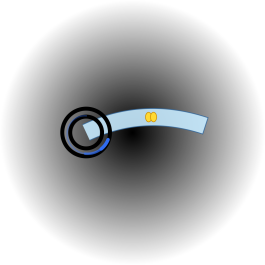
- Figure body: on the left sits a Filament core - a small double ring indicating a self-sustaining ring core with thickness. Extending to the right is a light-blue arc band = the color Channel, a Tension-binding band rather than a literal tube wall.
- Phase front: a blue phase arc appears on the Filament core, thickened at the leading edge, indicating the phase-locked Cadence.
- Gluon Wave Packet: a yellow "peanut-shaped" Wave Packet appears on the Channel, indicating a phase-energy Wave Packet propagating along the Channel - one exchange/relinking event, not a little ball.
- Figure elements: double ring = Filament core; light-blue arc band = color Channel; yellow = gluon Wave Packet; grayscale gradient = shallow basin.
- What the figure shows: a single quark unit is not closed. It becomes stable only when its color Channel docks with another partner.
2. Meson (binary closure; near-straight Channel)
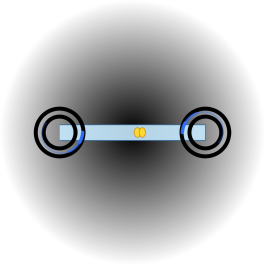
- Figure body: one Filament core sits on each side, and a near-straight color Channel docks them into an overall colorless whole.
- Phase front: a blue phase arc appears at both ends. A gluon Wave Packet (yellow) is placed in the middle of the Channel to indicate color exchange.
- Figure elements: the two double rings = the quark and antiquark Filament cores; the light-blue band in the middle = the color Channel; the yellow Wave Packet = the gluon; no electric arrows are drawn for the structure as a whole, because it is colorless.
- What the figure shows: a meson is a binary closed structure completed by a single color Channel linking the two Filament cores.