
In the microscopic lineage of particles, the proton has to be singled out not because it is “more fundamental,” but because it plays a highly unusual role: it is both one of the most typical composite lock-states in the hadronic world and, on cosmic timescales, a structure that appears capable of surviving for almost the entire history of the universe. Put differently, the proton packs two things that seem almost contradictory — short-range strong binding and long-term stability — into one and the same structure.
In mainstream accounts, the proton is usually described in two kinds of sentences. One is taxonomic: “it is made of three quarks and is a baryon.” The other is axiomatic: “baryon number is conserved, so it is stable.” Those two sentences are enough for calculation, but ontologically they still leave a debt unpaid: why do three quarks have to close in exactly this way? What, structurally, is the thing being conserved? And why can this structure remain self-sustaining under the continuous disturbance of the Energy Sea, while the neutron, though also a nucleon, decays in the free state?
In the materials language of Energy Filament Theory (EFT), the proton can serve as the long-term foundation of matter because it satisfies two sets of conditions at once, and the two sets reinforce one another. The Mechanism Layer tells us how it stays locked together and why pulling harder makes it bind tighter; the Rule Layer tells us which Gaps must be backfilled and which routes of deconstruction are not allowed. Superposed, the two make the proton an exceptionally deep lock-state basin under the current Sea State.
I. “Stability” as a testable condition: not an eternal slogan, but lock-state engineering
In EFT, “stability” is not a declaration that something “does not change.” It is a set of testable, comparable engineering conditions: can the structure sustain itself against persistent disturbance, can it recur, and can it preserve its identity without being rewritten across a certain range of environments? Writing stability that way keeps us from treating “stable particles” as heavenly decrees and then pushing every decay or conversion into an added law.
For the proton, two kinds of stability matter:
- Structural stability: are the internal closure and mutual support strong enough that thermal noise and scattering disturbances in the Energy Sea cannot easily tear it open?
- Identity stability: under the permitted interaction rules, is there any low-threshold path that can rewrite it into a different particle?
Mainstream discussions often merge “structural stability” and “identity stability” into a single word — “conservation.” In EFT they must be separated: structural stability is mainly a result of geometry and the Tension ledger; identity stability is mainly a result of the Allowed-Channel Set in the Rule Layer. The proton is so hard to eliminate precisely because these two forms of stability hold simultaneously in it and reinforce one another.
II. The proton’s minimal structural picture: three unclosed Filament cores → three converging color Channels → one mutually supporting whole
In the structural semantics of this book, a quark is not “a point + a fractional-charge tag.” It is an unclosed unit with a closed inner core that still leaves an unsealed bias port in the near field. In other words, it is “a Filament core + a color Channel port”: the Filament core provides the smallest identifiable kernel, while the color Channel port turns the unbalanced part of the local Tension and Texture outward into the Energy Sea. A single quark is hard to sustain not because it lacks an extra protective shell, but because that unsealed corridor structurally demands docking with something else.
The proton can appear because three quark Filament cores, none of which can endure for long on its own, happen to draw their three color Channels back into the near field through complementary orientations at the same time. They do not simply form a geometric triangle. They merge locally into one Y-shaped node and produce a ternary closure. The key is not just “there are three of them,” but that the three unclosed ledgers have to be balanced simultaneously. Remove one channel, and the whole structure is left with a Gap in a color port and cannot enter a deep lock-state.
The proton’s minimal structural picture can be reduced to three things:
- Three quark Filament cores: three local structures with closed inner kernels that each still leave behind a biased port;
- Three color Channels: three high-Tension corridors drawn out in the Energy Sea by the unbalanced Tension of the three Filament cores, converging locally into one Y-shaped node;
- One mutually supporting Tension distribution: the three Channels pull each local unclosed ledger back into the near field, allowing the whole to settle into a stable profile that can sustain itself for the long haul.
The advantage of this picture is that it does not depend on prior quantum numbers. It writes the identity of the proton directly as a repeatable mode of closure. The proton is not something that first gets named “a baryon.” It is the structural result of the fact that three unclosed Filament cores can remain self-sustaining for the long haul only when their ledgers are settled in this particular way.
III. The Mechanism Layer: why the proton gets tighter the farther it is pulled — confinement is not a separate lock, but the fact that the ledger does not permit disconnection
If you treat the proton merely as “three things stuck together,” you run into an immediate intuitive puzzle: if it is composite, why is it not easier to tear apart? EFT gives the opposite answer. Precisely because it is a composite formed by the unified closure of three color Channels, it is harder to rip apart than many structures that look simpler.
The core mechanism behind the proton’s strong binding is this: the three color Channels and the overall Tension distribution support one another, so “pulling farther apart” does not mean “loosening”; it means the ledger cost rises rapidly. The more you try to drag one quark Filament core away from the whole, the more the three Channels are drawn straight and pulled taut. The Tension bill along those Channels grows roughly linearly or even superlinearly, and the system becomes progressively less willing to persist in a long, thin, stretched shape.
Once the stretching cost crosses a threshold, the more economical move for the Energy Sea is not to let the Channel truly snap. It is to relink along the stretched region and nucleate new complementary ports, rewriting one long Channel into several shorter closed structures. Mainstream theory describes this as quark confinement. In EFT it is not an added law. It is the material consequence of closure priority: the structure is allowed to return to closure through pair creation and relinking, but it is not allowed to keep an infinitely extended color corridor whose cost keeps rising.
So the proton’s “strength” is not an extra glue-force. It is the outward appearance of three things superposed:
- Three-way closure: the Y-shaped convergence reduces the degrees of freedom for escape to a minimum;
- A rising-ledger mechanism: once a color Channel is stretched, its Tension cost rises quickly, so taking the proton apart becomes progressively less economical;
- Relinking with pair creation: the system prefers to generate new closed pieces in order to cut the loss, so what looks like taking it apart is rewritten as reorganizing into closure.
This Mechanism Layer explains why two appearances that seem separate always show up together: strong binding and confinement. They are not two independent properties, but two faces of the same ledger logic. Strong binding comes from the rising cost of pulling apart; confinement comes from the fact that that rising cost triggers relinking and loss-cutting.
IV. The Rule Layer: the proton’s long-term stability comes from the Allowed-Channel Set — the Strong Interaction backfills Gaps, the Weak Interaction rewrites spectra, but the proton lacks a low-threshold exit channel
The Mechanism Layer alone is not enough to explain survival on cosmic timescales. In a Sea that is continually being disturbed, any structure can be hit, excited, and pushed toward criticality. For “long-term” to hold, a second gate is needed: even if the structure is driven into certain deformation ranges, it still must not be able to rewrite its identity easily through some permitted Rule-Layer channel.
EFT repositions the Strong Interaction and the Weak Interaction as two types of action in the Rule Layer:
- The Strong Interaction acts more like Gap Backfilling: it tends to repair an incomplete lock into a complete one and pull the structure back toward closure and self-consistency;
- The Weak Interaction acts more like Destabilization and Reassembly: it allows certain high-cost winding modes to be rewritten and re-identified, steering the structure into a less expensive family of forms.
The proton’s long-term stability comes from the way these actions cooperate: under ordinary disturbances, it is easier for Strong-Interaction rules to pull it back into its own deep lock-state basin than for Weak-Interaction rules to open a low-threshold channel that rewrites its spectrum. In other words, under the current Sea State the proton is both deeply locked and short on cheap exit doors.
Volume 4 takes up the full inventory of strong and weak rules. Here the point is narrower: the proton is not stable because a word like “conservation” magically protects it. Its stability is the historical result jointly determined by a deep structural basin and the Rule-Layer Allowed-Channel Set.
V. Positive charge is not a tag: the Texture readout of “tighter outside, more relaxed inside” determines the proton’s macroscopic +1 appearance
In Sections 2.4–2.6, charge was defined as the orientational imprint of how tightness is distributed: tighter toward the outside appears as positive charge, tighter toward the inside as negative charge. The advantage of that definition is that it pulls charge back from an abstract quantum number into a structural profile, and it naturally explains why charge can be read out in the far field, because the distribution of tightness leaves a Texture response in the Energy Sea that can propagate and superpose.
The proton appears as +1 not because someone pasted a “+1” label onto it, but because once the three color Channels complete their closure, they stably compress the whole near field into a profile with higher Tension on the outside and relatively more relaxed structure on the inside. In the same terms used in Section 2.16, the electron’s positive and negative charges come from the radial bias of a single-ring cross-section; the proton’s +1 comes from the net positive orientation that the entire nucleon profile writes into the Energy Sea after ternary closure.
This also helps clarify two issues that are often misunderstood:
- “Fractional charge” in EFT: it is not chopped-up charge. It is the projection of the internal near-field orientational budget through different channels. In the far field, what is finally read out is still the net orientation of the whole profile.
- The Strong Interaction and Electromagnetism: do not fight each other. Electromagnetism reads the far-field Texture Slope, whereas strong binding reads the closure and rising ledger of the near-field color Channels. They operate at different layers of readout, which is why both can hold for the same object at once.
So the proton can participate in electromagnetic phenomena through its charge in the far field while exhibiting strong binding through color-Channel confinement in the near field. This is not a dual nature. It is one and the same structure being read in different ways at different scales.
VI. The ledger of mass and spin: the proton’s “heaviness” and “1/2” come from the internal distribution of Tension and circulation
Mainstream accounts often say that most of the proton’s mass comes from strong-interaction energy. In EFT, the same statement can be rewritten as a more visual ledger: the proton’s mass comes mainly from the channel Tension and self-sustaining energy required to hold the three color Channels in closure, not from some external assigning field pasting “bare masses” onto three quarks.
In EFT’s structural language, mass is not an extra property. It is the pull-taut cost and maintenance cost that a structure imposes on the Energy Sea. The proton is much heavier than the electron not because it is born intrinsically heavier, but because it contains a multi-channel geometry of Tension and mutual support that has to be maintained over the long haul. Once the three color Channels close, part of the energy is fixed into a Tension ledger that cannot simply leak away freely, and outwardly that appears as larger Inertia and a deeper basin in the Sea.
By the same token, the proton’s spin 1/2 should not be treated as a mysterious quantum number. It should be treated as a composite readout of internal circulation and channel torsion-wave activity: the overall twist of the Filament cores, the angular momentum carried by Wave Packets in the Channels, and the discrete allowed states of three-ring phase locking all combine to yield a stable and repeatable half-integer readout.
From this view, two long-standing questions fall back into materials intuition:
- The “spin decomposition problem”: it is no longer “who contributes an abstract 1/2?” It becomes “how is the angular-momentum ledger divided among the Filament cores, the channel Wave Packets, and the phase-lock modes?”
- “Mass and Inertia”: they no longer require an external field to assign them. They become natural consequences of structural closure and Tension cost.
VII. Why it can serve as the foundation of matter: three hard conditions have to be satisfied at once
To call the proton the long-term foundation of matter in EFT means that it satisfies three hard conditions simultaneously. Remove any one of them, and the hierarchical structure of matter breaks.
- Long-term persistence: under the current Sea State, it sits in an exceptionally deep lock-state basin, and ordinary disturbances have difficulty pushing it onto an exit channel;
- Participation in larger-scale Interlocking: the proton carries near-field Swirl Texture and the Texture left behind after color-Channel closure, so when it enters suitable nuclear-scale separations it can Interlock with other nucleons and relink binding bands, thereby forming the network nodes of atomic nuclei;
- Readable by electron orbitals: the proton’s positive-charge appearance provides electrons with a definable Texture Slope and boundary conditions, allowing electron orbitals — the set of allowed states — to form and thereby opening the higher structural chain of atoms, molecules, and materials.
Put differently, the proton is not just one particle that happens to be stable. It is the key interface that simultaneously connects the network of nuclear-scale Interlocking and the orbital architecture of the atomic scale. Because it persists for the long haul, the universe can build not only brief jets and radiation events, but also elements, chemistry, and complex materials.
VIII. Testable readouts: turning “the proton is a structure” into something experiments can actually probe
If “the proton is a structure” is to count as more than a phrase, we need to identify the observations that serve as its structural fingerprints. Three readouts are especially important, and later volumes return to them directly.
Chiral response of near-field Texture: if a probe beam carries controllable orbital angular momentum (OAM) chirality, then under fixed geometry and readout conditions the sign of the phase shift in near-field scattering or transmission by the proton should agree with the proton’s outward-pointing Texture chirality. When the OAM chirality of the probe is flipped, the sign of the phase shift should flip with it and do so reversibly. This readout brings the geometry of “tighter outside, more relaxed inside + Swirl-Texture organization” back to a measurable phase.
Wave Packets along the color Channels that maintain stability: the proton’s three internal color Channels are not static ropes. They have to maintain a dynamic steady state. The deformation Wave Packets running along those Channels are the repair packets that maintain structural stability and make Gap Backfilling possible. Mainstream theory formalizes them as gluons. Volume 3 of this book rewrites them uniformly as disturbance-resistant Wave Packets on the color Channels and places them within the broader Wave-Packet lineage.
Nuclear-scale Interlocking and binding bands: when a proton enters the nuclear scale and meets the alignment threshold, its near-field Swirl Texture can Interlock with other nucleons, and the Energy Sea can open binding bands across nucleons, producing the appearance of short-range strong binding, saturation, and a hard core. Volume 4 systematizes this mechanism as the Mechanism Layer of the Nuclear Force and crosswalks it against the Rule Layer of the Strong Interaction.
Together, these three readouts serve a single aim: to move “the proton is stable for the long haul” from a taxonomic fact to a structural consequence readable through multiple channels. In EFT, the key is not to rename things. It is to write the causal chain behind the names clearly enough to be tested again and again.
IX. Illustrative diagram
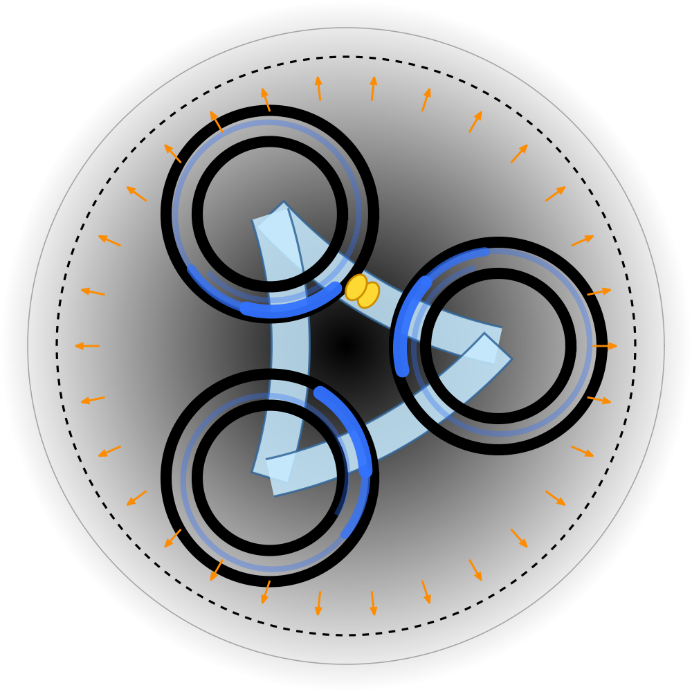
- Main body and thickness
- Three Filament cores + three color Channels: the three ring-like centers in the figure are the closed inner cores of the three Filament cores; the double solid lines indicate only a self-sustaining ring center with thickness, not three complete closed-loop particles that could each survive independently for the long haul. The real stable base comes from the way the three color Channels merge into a single Y-shaped node in the near field and pull the unclosed ledger back into the near field.
- Equivalent circulation / annular flux: the proton’s magnetic moment comes from the combination of equivalent circulation / annular flux, not from a visible geometric radius (the main ring in the figure is therefore not drawn as a “current loop”).
- Color Channel (the high-Tension Channel)
- Meaning: it is not a physical tube, but a high-Tension Channel pulled out of the Energy Sea by Tension and orientation — a band in the binding-potential landscape.
- Shown as an arc band: this lets the reader see at a glance where the structure is tighter and where channel obstruction is lower. The color and band width are only visual coding; they do not represent a physical tube wall.
- Crosswalk: in mainstream language, this layer is usually booked through color-flux bundles or color-channel variables; at high energies or in short time windows it converges to the parton picture and does not introduce any new “structural radius.”
- In the figure: three light-blue arc bands connect the three Filament-core nodes, indicating near-field color Channels defined by phase locking plus Tension balancing.
- Gluon Wave Packet
- Meaning: not a little ball or solid lump, but a localized phase-energy Wave Packet propagating along a high-Tension Channel — one exchange / relinking event.
- Icon only: the yellow “peanut shape” only indicates that an exchange Wave Packet is present there; it does not represent a particle chunk that could be imaged for the long haul.
- Crosswalk: it corresponds to quantum excitation / exchange in the gluon field; in observable quantities it remains aligned with mainstream numerical results.
- Phase cadence (not a trajectory)
- Blue spiral phase front: positioned between the inner and outer boundaries of each main ring, indicating phase-locked Cadence and chirality; stronger at the leading edge and fading toward the tail.
- Not a trajectory: the “running” of the phase band is the migration of a pattern front, not superluminal motion of matter or information.
- Near-field orientational Texture (defining positive charge)
- Small orange radial arrows (pointing outward): short outward arrows arranged around the outer edge of the whole figure define the proton’s positive-charge Texture in the near field.
- Microscopic meaning: motion in the direction of the arrows encounters lower obstruction, while motion against them encounters more; statistically this corresponds to the source of attraction and repulsion.
- Mirror of the electron: one-to-one mirror of the electron’s inward-pointing arrows.
- Mid-field “transition cushion”
- Dashed ring: smooths the patterned near field into a simpler intermediate zone, bridging anisotropy and the time-averaged isotropic appearance; it gives an intuitive sense of positive outward spread and inward cohesion inside the ringed domain.
- Reminder: this “outward spread” is only visual language; numerically it remains consistent with the measured charge radius and form factor (it does not add new patterning).
- Far field: a deeper, broader shallow basin
- Concentric gradient + contour rings: an axisymmetric shallow basin that is deeper and broader, representing the proton’s weightier mass appearance and stronger guidance; there is no fixed dipolar off-centering.
- Thin solid line (reference line): the thin solid circle in the far field is a reference line / scale marker used to locate the radius for reading the figure; it has nothing to do with a physical boundary. The gradient may extend to the edge of the frame, but readouts are referenced to the thin solid line.
- Figure elements
- Blue spiral phase front (inside each main ring)
- Color-Channel arc bands (three high-Tension Channels)
- Gluon marker (yellow; Wave-Packet exchange / relinking)
- Orange outward arrows (near-field orientational Texture = positive charge)
- Outer edge of the transition cushion (dashed ring)
- Far-field thin solid line and concentric gradient
- Reading notes
- Point-like limit: at high energies or in short time windows, the form factor converges toward a near-pointlike appearance (this figure does not imply a new structural radius).
- Intuitive aid only: “outward spread / Channels / Wave Packets” are purely visual language and do not alter existing numerical values such as the charge radius, form factor, or parton distribution.
- Source of magnetic moment: it comes from equivalent circulation / annular flux; any environment-induced slight offset must be reversible, reproducible, and calibratable.