
The neutron is one of the most instructive boundary cases in the microscopic lineage. Like the proton, it belongs to the nucleon family: a nucleon lock-state built from three quark Filament cores whose three color Channels complete a ternary closure at a Y-shaped node. Yet in the free state it does not remain self-sustaining for long. On average it lasts only on the order of minutes before exiting through β- decay. At the same time, inside many atomic nuclei a neutron can survive for the long term as a node within the nuclear network, and in stable nuclides it is often indispensable.
If particles are written as “points + quantum-number stickers,” those facts can only be split into two disconnected axioms: one sentence says that “the Weak Interaction permits neutron decay,” and another says that “binding energy rewrites the decay condition.” Put them back on one structural map, and lifetime is no longer a static tag printed in the particle table. It becomes a reading jointly determined by the depth of the ternary-closure lock-state, the permitted set of spectrum-rewriting channels, and the thresholds imposed by the environment. So when a neutron is “more stable inside a nucleus,” the nucleus is not supplying some mysterious extra hand that pins it down. The nuclear environment is raising the cost of certain spectrum-rewriting paths and making certain final-state positions unavailable, thereby pushing a free, easily decaying structure back into a deeper lock-state basin.
I. The same ternary closure, but with the electrical Texture rewritten as a cancellation balance
A neutron is not, first of all, “a zero-charge point.” It is a ternary-closure nucleon of the same lineage as the proton: three quark Filament cores, each carrying an unsealed color-port bias, draw together through three color Channels in the near field and merge at a single Y-shaped node, sealing the color corridor back into the near field. In other words, what the neutron and proton truly share is not the taxonomic label “both are nucleons,” but one structural diagram: three Filament cores + three color Channels + closure at a Y-shaped node.
What separates them is not whether ternary closure exists, but how the three Filament cores write electrical Texture into the overall near field. The proton writes a stable net outward bias into the whole cross-section — tighter outside, more relaxed inside — so the far field reads out a +1 positive-charge appearance. The neutron, by contrast, packs outward and inward radial orientations into the same ternary closure and lets them approximately cancel from the mid field outward, which is why it appears electrically neutral. Neutrality does not mean “no electrical structure.” It means that the electrical structure is balanced by cancellation. The near field still preserves zoned Texture, which is why appearances such as a negative-sign charge radius and a nonzero magnetic moment remain possible.
Precisely because it has to compress positive and negative bias into the same ternary closure, the neutron usually sits closer to criticality than the proton. The proton is more like a deep lock-state that gathers Tension and orientation into a one-way inward accounting. A free neutron is more like a semistable configuration that stands only because multiple complementary paths and a fine balance happen to hold together at once. It is not a “failed proton.” It is a repeatable structure built on the same nucleon skeleton under a different electrical balancing condition — one that is simply more sensitive to environmental Tension, boundary conditions, and disturbance.
II. Why a free neutron undergoes β- decay: one spectrum-rewriting reconfiguration inside the same ternary closure
The canonical exit of a free neutron is β- decay: the neutron converts into a proton while emitting an electron and an electron antineutrino. Mainstream language writes that as a charged-current process of the Weak Interaction. In EFT, the same process can be restated in more materials-based terms: on the same ternary-closure platform, the neutron has access to a spectrum-rewriting path that is cheaper than its present state. When local disturbances in the Sea State push the structure toward a critical mouth, the winding order and phase-locking mode of one Filament core can be rewritten, and the whole switches from the neutron’s cancellation-balanced configuration to the proton’s net outwardly biased configuration.
This kind of exit is not a direct dismantling of the ternary closure, and it certainly is not a matter of “letting quarks run free.” It still happens under the rule that closure is preferred. More precisely, β decay is a typical case of “same platform, rewritten spectrum, plus companion nucleation”: the overall nucleon skeleton remains, but the flavor-mode winding order of one Filament core is rewritten, the three color Channels and the Y-shaped node redistribute the ledger, and the nucleon’s identity is accordingly rewritten from neutron to proton.
- Step 1: under a critical disturbance, the internal winding order and phase locking of one Filament core are rewritten, the three color Channels redistribute their Tension at the Y-shaped node, and the overall ternary closure switches from the neutron’s cancellation-balanced electrical configuration to the proton’s net-positive configuration.
- Step 2: for the charge ledger and the lepton ledger to close at the same time, the Energy Sea nucleates an electron during the reconfiguration. What is produced here is not a temporary label, but a long-lived closed single-ring electron consistent with Section 2.16. At the same time, an electron-antineutrino phase band must also be emitted to carry away the surplus phase, angular momentum, and lepton bookkeeping.
- Step 3: the energy difference, Tension difference, and phase difference before and after the rewrite are distributed into the electron, the electron antineutrino, the kinetic energy of the products, and far-field Wave Packets, completing the exit as a closed loop.
In this account, conservation laws are no longer external axioms added from outside. They are structural consequences of the fact that the ledger has to close. β- decay has to produce a proton, an electron, and an electron antineutrino together not because nature prefers to gather a trio, but because the entire chain — Filament-core spectrum rewriting → ternary-closure reconfiguration → companion nucleation → outward carrying of energy — has to keep the ledgers of charge, energy-momentum, angular momentum (including spin readout), baryon number, and lepton number aligned at the same time.
But there is still a frequently ignored question: if a free neutron already has a cheaper exit path, why does it not decay instantly? The answer is still “thresholds.” Switching from neutron to proton is not a casual relabeling. It has to cross several process thresholds at once: Filament-core rewriting, re-accounting at the Y-shaped node, and companion nucleation. Because those thresholds exist, the exit is statistical rather than immediate. Within any very short time window it may happen or may not happen; only after long-time statistics do we recover a stable exponential lifetime.
So the lifetime of a free neutron is not a constant “written into it by birth.” It is a structural reading jointly determined by three kinds of factors:
- Lock-state depth: how close the cancellation-balanced ternary closure sits to criticality, and how taut its internal balance is, determines the intrinsic tendency toward spectrum rewriting.
- Allowed-Channel Set: which Filament-core rewritings and spectrum changes are permitted at the Rule Layer — corresponding to channel permission in the Weak Interaction — determines which exit routes are actually available.
- Environmental thresholds: how local Tension, boundary conditions, and external fields raise or lower the critical mouth determines the triggering probability.
III. Why a neutron is more stable inside a nucleus: how the environment rewrites the available channels and thresholds
Once a neutron is placed inside an atomic nucleus, it is no longer an isolated ternary closure. It becomes one node in the nuclear network. Other nucleons are nearby, and cross-nuclear corridors can grow between them, linking multiple nodes into an interlocking network with saturation and geometric capacity limits. In EFT language that means two things happen at the same time:
- The local Sea State is “thickened” by the nuclear network: the Tension landscape and orientational Texture are no longer those of free space, but are jointly rewritten by cross-nuclear corridors and neighboring nucleons.
- The neutron’s ternary closure is reinforced by the network: constraints from the external network alter the force balance near the Y-shaped node and the occupancy of final states, making some internal spectrum rewritings harder to trigger and making some post-conversion arrangements more costly.
That is the materials translation of “more stable inside a nucleus.” The change in stability comes from the systematic rewriting of spectrum-rewriting thresholds by the network’s boundary conditions, not from the addition of some new independent entity. In mainstream energy language, the same statement is that binding energy, Coulomb cost, and final-state occupancy are jointly rewriting the threshold.
In nuclear physics, one commonly uses the Q value (released energy) to judge whether β decay is possible. If the total energy is lower after the conversion (Q > 0), the channel opens; if it is higher (Q < 0), the channel closes. For β- decay inside a nucleus — one neutron converting into one proton — the atomic-mass form can be written as:
Qβ- = [M(A,Z) - M(A,Z+1)] c^2
In more intuitive ledger terms, this means the following: in free space the neutron–proton–electron mass difference provides a baseline release, but inside a nucleus the difference in nuclear binding energy, the difference in Coulomb energy, and the cost of final-state occupancy all add to or subtract from that baseline. When “the extra Coulomb cost of one more proton + the cost of final-state occupancy” exceeds the baseline release, Q turns negative and β- decay is shut off directly by the energy threshold.
Beyond the total-energy threshold, the nuclear environment can raise the barrier further through final-state availability. Nucleons inside a nucleus do not simply land wherever they like. They are constrained jointly by shell structure, pairing, and the geometric capacity of the network. If the proton produced by the conversion would have to occupy a higher allowed state, or would have to break an existing balance in order to land at all, the effective threshold moves upward and the decay is suppressed even further.
That also explains an apparently contradictory fact: it is not true that “all neutrons inside nuclei are stable.” In many unstable nuclides, nuclear neutrons still undergo β- decay. By the same token, although a free proton is stable, inside some nuclei a proton can still convert into a neutron through β+ decay or electron capture. At bottom, the same judgment still applies: the environment has changed the available channels and the thresholds.
So “more stable inside a nucleus” must be read as a conditional statement, not as an absolute one:
- When the cross-nuclear corridors and Tension landscape of the nuclear network make the n→p spectrum-rewriting path no longer more economical in the energy ledger — or make the final state unavailable — a neutron inside the nucleus can remain stable for the long term.
- When the nuclear network sits in an imbalance of “too many / too few neutrons,” and spectrum rewriting can lower the total Tension cost, β decay becomes the system’s spontaneous path for repairing the ledger.
IV. Lifetime as a “structural reading”: when the same particle has different lifetimes in different environments, that is the rule, not the exception
Once the neutron is written as a structure, lifetime has to leave the stage as an “intrinsic constant” and become a materials reading that can be calculated, compared, and shifted. The reason is simple: every decay is the outcome of channel competition, and the opening and strength of those channels are jointly controlled by rules, thresholds, and environment.
This can be written as:
Γtotal = Σi Γi, τ = 1 / Γtotal
Here Γi is the occurrence rate — or equivalent line width — of the i-th exit channel, and it is governed by at least four kinds of factors:
- Rule permission: whether a given channel is allowed at all, and to what degree it is allowed (Weak-Interaction rules, Strong-Interaction rules, and the broader permitted-channel set).
- Thresholds and phase space: the size of Q determines the available phase space. The higher the threshold and the narrower the phase space, the lower the rate.
- Lock-state geometry: the force profile of the ternary closure, the accounting pattern at the Y-shaped node, and the energy barrier that the Filament-core rewrite must cross determine how difficult the reconfiguration is.
- Environmental boundaries: external fields, density, Tension gradients, neighboring structures, and boundary materials rewrite the local Sea State, thereby changing both thresholds and barriers.
The neutron is simply the clearest example. In one and the same narrative it lets the reader see both “easy to decay in the free state” and “stabilized when embedded in a network.” Once that structural sentence is accepted, many phenomena that mainstream accounts handle as though they needed “extra rules” naturally become different projections of the same mechanism: the stable band and the half-life distribution of isotopes, shell effects, pairing effects, and even systematic differences between lifetime measurements made with different apparatuses can all be understood in one frame — thresholds are being rewritten differently in different environments.
V. Measurement and statistical readouts: why a lifetime reading has to carry its apparatus environment with it
Experimentally, lifetime is not something one “sees” directly. It is obtained statistically: many exit events are accumulated into a time distribution, and τ or the half-life is then fitted from that ensemble. In the lock-state / threshold picture, that point becomes especially important. The measuring apparatus is not a transparent background. Through its boundaries, field geometry, and material conditions, it can rewrite the local Sea State and thereby change the rate of certain channels.
For free-neutron lifetime measurements, two common experimental strategies are used:
- “Bottle method”: trap ultracold neutrons in a magnetic trap or a physical container, and count the number of neutrons N(t) still surviving as time passes.
- “Beam method”: let a neutron beam pass through the detection region, count the decay products (such as protons or electrons) or the decay rate, and infer the neutron’s mean lifetime in reverse.
Mainstream theory usually expects the two methods to converge to the same lifetime in the ideal limit and treats any discrepancy mainly as a matter of systematic error. But under EFT’s view that “lifetime = structural reading,” the apparatus environments of the two methods are not equivalent. The bottle method keeps neutrons for long durations inside a particular set of boundaries and field geometries, whereas the beam method lets neutrons propagate through a different Tension distribution and scattering background. If the neutron is indeed a semistable ternary closure sitting near criticality, then even a small environmental sensitivity of the threshold can be amplified into a measurable lifetime difference.
That does not mean “lifetime is arbitrarily variable,” nor does it mean that apparatuses may manipulate particle properties at will. It means only this: once lifetime is treated as a structural reading, the reading has to carry its measurement conditions with it. In statistical language, apparatus differences are equivalent to changing certain contributions inside Γtotal, thereby shifting the fitted value of τ.
So the later volume on “measurement and statistical readouts” will keep two questions separate:
- The statistical question: how to estimate τ reliably from a finite number of events, background counts, and detection efficiency (exponential decay, Poisson fluctuation, and the propagation of systematic uncertainty).
- The ontological question: whether the apparatus environment changes the thresholds and therefore changes the true Γtotal being estimated (whether boundaries, gradients, and material interactions enter as lock-state engineering parameters).
VI. Free decay and nuclear reinforcement: two expressions of the same structure in different environments
The two facts “the neutron decays” and “inside nuclei it is more stable” have to be written back onto one structural map. The neutron and proton are both ternary-closure nucleons built from “three quark Filament cores + three color Channels + a Y-shaped node,” but the neutron writes its electrical Texture as a cancellation balance and therefore sits closer to criticality overall. In the free state it has a cheaper path that rewrites one Filament core into the proton configuration (β- decay), yet that path still has to cross the thresholds of Filament-core rewriting, node re-accounting, and companion nucleation, so the exit remains statistical rather than instantaneous.
Once inside an atomic nucleus, the nuclear network rewrites the threshold and feasibility of that spectrum-rewriting path through cross-nuclear corridors, differences in binding energy, Coulomb cost, and final-state occupancy, so in many cases the same structure now presents as long-term stable. In that way, “the same particle has different lifetimes in different environments” is no longer an anomaly that needs an extra explanation. It is a direct expectation of a structural theory: lifetime is a reading of channel competition, and channels are jointly shaped by rules and environment.
VII. Illustrative diagram
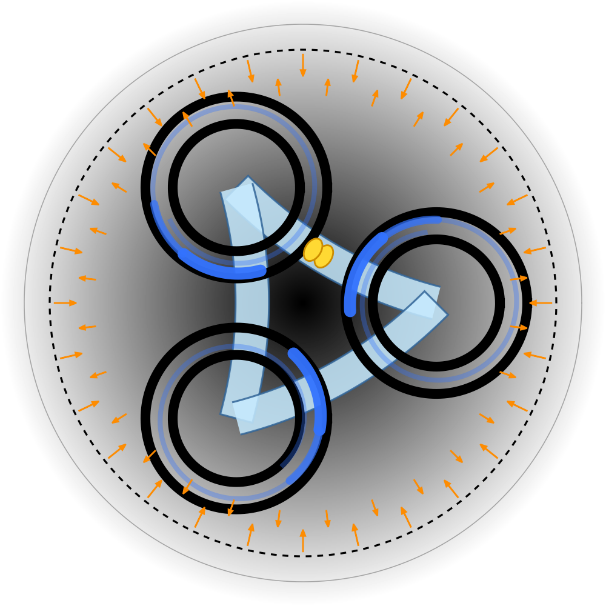
- Main body and thickness
- Three Filament cores + three color Channels: the three ring-like centers in the figure are the visualized closed inner kernels of the three Filament cores within the ternary-closure platform. The double solid lines indicate only “self-sustaining ring cores with thickness.” Overall stability comes from the balancing completed by the three color Channels in the near field, not from three fully independent long-lived closed loops simply placed side by side.
- Equivalent circulation / annular flux: the neutron’s magnetic moment comes from the combined equivalent circulation / annular flux and does not depend on a visible geometric radius (so the image should not be read with the intuition of a literal current loop).
- Color Channel (the high-Tension Channel)
- Meaning: it is not a physical tube wall, but a high-Tension Channel pulled out of the Energy Sea by Tension and orientation — a band in the binding-potential landscape.
- Shown as an arc band: this lets the reader see where the structure is tighter and where channel obstruction is lower. Color and band width are only visual coding.
- Crosswalk: in mainstream language this layer is usually booked through color-flux bundles / color-channel variables; at high energies or in short time windows it converges toward the partonic picture, without introducing any new “structural radius.”
- In the figure: three light-blue arc bands connect the three Filament-core nodes, expressing the near-field color Channels defined by phase locking plus Tension balancing.
- Gluon Wave Packet
- Meaning: it is a localized phase-energy Wave Packet propagating along a Channel — one exchange / relinking event — not a stable little ball.
- Icon only: the yellow “peanut shape” is only an event marker. Its long axis follows the tangent direction of the Channel, indicating transmission along the Channel.
- Crosswalk: it corresponds to quantum excitation / exchange in the gluon field; observable quantities remain aligned with mainstream numerical results.
- Phase Cadence (not a trajectory)
- Blue spiral phase front: positioned between the inner and outer boundaries of each main ring, indicating the phase-locked Cadence and chirality; stronger at the leading edge and fading toward the tail.
- Non-trajectory note: the “running” of the phase band is the migration of a pattern front, not superluminal motion of matter or information.
- Near-field orientational Texture (charge cancellation)
- Double-ring arrow bands (orange): the arrows in the outer ring point inward (the component associated with a negative-charge appearance, closer to the outer rim), while the arrows in the inner ring point outward (the component associated with a positive-charge appearance, closer to the inside). The two rings are angularly staggered, indicating that in the time average the outward and inward biases cancel one another, so the far-field electrical appearance goes to zero.
- Visual cue: this “outer-negative / inner-positive” weighting pattern also provides a geometric hint for why the mean-square charge radius carries a negative sign (numerical values remain those of mainstream data).
- Mid-field “transition cushion”
- Dashed ring: smooths the fine-grained near field into a simpler intermediate zone, bridging local anisotropy and the time-averaged isotropic appearance; the neutral appearance becomes progressively explicit there.
- Note: this visible appearance does not alter the measured form factor or radius; it is only an aid to intuition.
- Far field: a “symmetric shallow basin”
- Concentric gradient + contour rings: an axisymmetric shallow basin representing a steady mass appearance, with no fixed dipolar off-centering.
- Thin solid line (reference line): the thin solid circle in the far field is used only to locate the reading radius and scale in the figure. It is not a physical boundary. The gradient may extend to the edge of the frame, but readouts are referenced to the thin solid line.
- Figure elements
- Blue spiral phase front (inside each main ring)
- Color-Channel arc bands (three high-Tension Channels)
- Gluon markers (yellow, placed along the Channels)
- Double-ring orange arrow bands (outer ring inward, inner ring outward)
- Outer edge of the transition cushion (dashed ring)
- Far-field thin solid line and concentric gradient
- Reading notes
- Point-like limit: at high energies or in short time windows, the form factor converges toward a near-pointlike appearance (the present figure does not imply any new structural radius).
- For intuition only: “cancellation balance / Channels / Wave Packets” are purely visual language and do not alter existing numerical values such as the form factor, radius, or parton distribution.
- Source of magnetic moment: it comes from equivalent circulation / annular flux; any environment-induced slight offset must be reversible, reproducible, and calibratable.