
The atomic nucleus is one of the most “engineered” objects in the microscopic world. It is neither a simple scaled-up version of a single particle nor the result of some independent short-range force pulling from afar without interruption. It is a self-sustaining network: a set of nucleon nodes that complete Interlocking at close range through cross-nuclear corridors and are then filtered by the Rule Layer. Within that network, nuclear-physics appearances such as “strong binding after close approach,” “short-range yet extremely strong,” “saturation,” the “hard core,” and the belt / valley of stability can, for the first time, be compressed back into one structural language.
Mainstream narratives usually write the Nuclear Force as “another independent short-range force,” and then describe different appearances piece by piece with exchange bosons, effective potentials, shell models, and related tools. In EFT, those appearances can be traced to three structural components: nucleons as ternary-closure nodes, cross-nuclear corridors that grow out once nucleons are close enough, and the structural topographic map that emerges once a network has formed. Stability is no longer “a hand that keeps pulling,” but something closer to “once it has latched, it is not easy to unlock.” Saturation is no longer “the force gets smaller,” but “interface capacity has an upper limit.” The hard core is no longer “a new repulsive force,” but “once crowding sets in, forced rearrangement becomes unavoidable.”
Here the mechanism layer comes first: how nucleons establish cross-nuclear corridors in the near field, how a network grows the outward appearance of short-range strong binding, and how the valley of stability appears as the topographic map of nuclides. Which spectrum-rewriting Channels are allowed, which Gaps are repaired by the Rule Layer, and which nuclear states are dismantled or rewritten are still taken up in Volume 4.
I. The atomic nucleus as a “cross-nuclear corridor network”: nucleons as nodes, corridors as edges
To understand the atomic nucleus, the first step is to abandon the picture of “little balls glued together by a force” and switch to network language. Saying that the nucleus is made of protons and neutrons is a taxonomic description. In EFT, the more important point is that the proton and the neutron both belong to the same class of nucleon nodes. Their core ontology is the same ternary closure: three quark Filament cores + three color Channels + a Y-shaped node. The difference is that the proton writes a net positive electrical Texture, whereas the neutron organizes its electrical Texture as a cancellation balance.
When two nucleons enter a suitable range of close approach, they do not immediately generate one continuously strengthening attraction. They first encounter a docking window. The surface Tension distribution, the near-field Texture, the phase relation, and the geometric orientation of the available ports must all fall into the allowed region before a cross-nuclear corridor can form. If they miss that window, they merely brush past one another. Once they enter it, however, the system’s degrees of freedom drop sharply, and outwardly the event looks like a sudden “latching on.”
Once a cross-nuclear corridor is established, the Energy Sea opens a new low-cost connection between the two nucleons. It is not an extra physical line added from outside, nor does it expose quarks again. It is a cross-node Tension corridor formed when the near-field boundaries of neighboring nucleons relink, extend, and become shared under close-contact conditions. If the nucleons are read as nodes and the cross-nuclear corridors as edges, then the atomic nucleus is a self-sustaining network woven from nodes and edges.
From this point of view, nuclear stability no longer has to be translated as “some hand keeps pulling.” It becomes “there is a clear unlocking threshold, so taking the network apart requires paying the costs of relinking, backfilling, and final-state rearrangement.” The atomic nucleus does not hold together because it is smeared with glue. It holds together because it has latched.
II. Threshold-type binding: why nuclear binding is short-range yet strong
Nuclear-scale binding is “short-range” not because it is weak, but because cross-nuclear corridors impose a hard requirement on the overlap region. Nucleons have already completed ternary closure, but their surfaces still retain readable near-field Texture and Tension boundaries. Only when those boundaries are spatially close enough for a real allowed region to appear is there somewhere for a corridor to grow. A little farther apart, no overlap region exists, so no cross-nuclear corridor can form, and the outward appearance dies away quickly.
Nuclear-scale binding is “strong” for the same reason, and it does not require a steeper long-range slope. Once the docking window has formed, three kinds of strong constraints appear in the network at the same time:
- Geometric constraint: a cross-nuclear corridor locks the relative orientation of the two nucleons into a limited window, sharply compressing the available freedom for rotation, sliding, and flipping.
- Ledger constraint: the corridor does not merely connect the surfaces of two nodes. It recouples the Tension and phase ledgers inside their respective ternary closures, so unlocking it means crossing several repartition thresholds at once.
- Channel constraint: once a nucleon has entered the network, taking it out is not simply “returning it to its original position.” Surface Gaps are exposed, final-state occupancy must be rearranged, and the Rule Layer may impose backfilling / rewriting thresholds, all of which make exit more difficult.
So “strong” here is not expressed mainly as continuous pulling over long distance. It is expressed as this: once the structure has latched, it is hard to take apart. The strength of nuclear binding is closer to the bite depth of a latch and the cost of unlocking it than to an attraction slope that extends without limit.
III. Saturation: interface capacity and the “upper limit on connectivity” produced by cross-nuclear corridors
Once nuclear binding is understood as a cross-nuclear corridor network, saturation stops being mysterious. The edges of that network are not a gravitation-like superposition that can be piled up without end. They are a weave with capacity limits. The number of surface interfaces each nucleon can provide is finite; the total load that the Y-shaped node can bear is finite; and the angular distribution over which electrical Texture and neutral Texture can be balanced simultaneously is also finite.
As the number of nucleons rises from 2 to more, the network at first becomes rapidly more stable, because there are more usable edges and boundary Gaps are easier to backfill. But as the interfaces on each node gradually fill up, the marginal gain brought by each additional nucleon drops quickly. At the same time, increasing the number of protons raises the crowding cost of electrical Texture. That naturally yields the standard outward appearance: the Nuclear Force is short-range, the binding energy shows saturation, and nuclear density stays approximately constant over a broad range.
In this framework, “binding energy / mass defect” is no longer an extra nuclear fact that has to be memorized from outside. It is a direct ledger consequence of the cross-nuclear corridor network. Once several nucleons are woven into a network, they no longer maintain all of their surface Tension boundaries independently. In the edge regions, part of the near-field rewriting becomes shared and merged. Repeated maintenance is deduplicated, and the total system cost drops.
Mainstream language calls that drop the “mass defect” and converts it, by equivalence, into releasable energy. EFT’s sentence is more concrete. What is reduced is not the ontology of the object, but the form of the inventory. Tension inventory that had previously been stored separately on the boundaries of individual nucleons is replaced, after sharing through cross-nuclear corridors, by a more ledger-economical whole-network loop. The excess inventory is expelled into the boundary and the background as Wave Packets, thermalization, or other viable channels. As long as boundary flux and background rewriting are booked together, the so-called “defect” is just a migration within the settlement.
The ledger process can be broken into three lines:
- Before Interlocking: each nucleon maintains its own independent boundary and near-field Tension footprint, and the footprints are difficult to share, so the total cost is high.
- After Interlocking: cross-nuclear corridors grow in the edge regions, the boundary footprints are deduplicated, and a deeper whole-network self-consistent loop is formed, so the total cost drops.
- Where the difference goes: it is released as propagating states that leave the system (Wave Packets) or as background thermalization, while the total initial and final ledgers still close.
Saturation can be summarized directly: the atomic nucleus is not “a system in which every node attracts every node without limit,” but “a system in which each node can carry only a finite number of connections and a finite balancing window.” Once that capacity is used up, the network enters the stage where “adding more members no longer means stronger binding.”
IV. The hard core: becoming more “repulsive” at shorter distance is not a new force, but crowding and forced rearrangement
Textbooks often describe the Nuclear Force with the outward appearance of an effective potential that shows “short-range repulsion - intermediate-range attraction - long-range disappearance.” EFT more directly reads that “short-range repulsion” as an engineering phenomenon: crowding.
Once a cross-nuclear corridor has latched, forcing the nucleons even closer does not make the attraction grow without bound, because the weaving space is finite, interface capacity is finite, and both the Y-shaped node inside the nucleon and the surface Texture have to remain self-consistent. Overcompression produces topological crowding. Corridor angles can no longer all be satisfied at once, electrical Texture and neutral Texture pile up too densely in local regions, the internal force distribution is forced into a global rewrite, and the network has to enter violent rearrangement in order to avoid self-contradiction.
Rearrangement means that the cost rises abruptly. Outwardly, that cost looks like a “hard-core wall.” It is not a new repulsive entity appearing from nowhere. It is the network’s strong feedback against over-dense packing. That is why nuclear-scale structure naturally shows a three-stage appearance:
- At moderately close distance: the docking window is easy to satisfy, cross-nuclear corridors form, and strong attraction / strong binding appears.
- At even shorter distance: corridors and nodes enter the crowding zone together, and only forced rearrangement can preserve self-consistency, so outwardly a hard-core repulsion appears.
- At larger distance: no overlap region exists, cross-nuclear corridors cannot form, and the outward appearance quickly dies away.
Read this way, it also becomes clear why the hard core is not an absolutely impenetrable “forbidden region,” but rather a region where the cost is extremely high and passage becomes possible only by switching to a different configuration. Such configuration changes often require short-lived transitional states, local relinking, or intervention by the Rule Layer at higher cost.
V. Interlocking does not automatically mean stability: the locking window and the Rule Layer jointly determine which nuclear states can last over the long haul
Cross-nuclear corridors explain why nucleons can latch, but they do not yet answer why some nuclei latch for a long time while others fall apart almost as soon as they latch. That is precisely the nuclear-scale version of the locking window. For a nuclear state to become an atomic nucleus that can endure over the long haul, it must satisfy a whole set of parallel conditions. Local attraction alone is not enough.
At nuclear scale, the locking window contains at least four engineering conditions: closure, self-consistency, disturbance resistance, and repeatability. In network language, that becomes a more concrete set of constraints:
- Geometric admissibility: the connection count of the nodes, the angular distribution of the corridors, and the overall shape all have to remain inside a load-bearing window, so that the network avoids chronic crowding or chronic missing edges.
- Texture balanceability: the electrical Texture, neutral Texture, and phase relations inside the network must be able to close. If there is an irreducible balance frustration, the nuclear state falls more easily into a resonance or a transient.
- Boundary repairability: “Gaps” on the surface of the network are unavoidable. There must be a path for the Rule Layer to complete the necessary backfilling; otherwise a semi-stable state cannot be deepened into a strongly locked one.
- Channel closure: if some Destabilization and Reassembly channels are cheaper in the ledger, the structure will spontaneously leave along those routes. A nuclear state that can last over the long haul is equivalent to one in which the main exit channels are sealed by thresholds or lifted by the environment.
These conditions make phenomena such as “neutrons are more stable inside nuclei, while free neutrons decay more readily” feel natural. The same nucleon, placed in different networks and under different boundary conditions, will see changes in the number of cross-nuclear corridors, the final-state occupancy, the local Tension topography, and the available spectrum-rewriting Channels. Lifetime is therefore a structural reading, not an inborn label.
VI. Shells, magic numbers, pairing, deformation, and collective modes: the network geometry of textbook phenomena
Once the atomic nucleus is written as a network, the long string of names in nuclear-structure theory that ordinarily look scattered fall back into a few geometric consequences that can be understood directly. No new hypothesis is introduced here. The aim is simply to restate familiar phenomena in EFT’s structural language.
- Shells and magic numbers: in network language, these are closer to “capacity steps.” Nucleons are not structureless points. They are nodes that carry a ternary-closure chassis and a finite set of interfaces. When the network fills one especially economical combination of interfaces and corridor arrangements, a marked steady-state step appears. Crossing to the next combination requires a larger cost, so exceptionally stable points and unusually unstable gaps appear.
- Pairing effect: cross-nuclear corridors impose window requirements on orientation, Texture, and final-state occupancy, so “balanced pairing” often closes the total ledger more easily than a lone placement does. Even-even nuclei are more stable and odd-odd nuclei are more delicate not because an extra mysterious pairing force has been added, but because interfaces are easier to twin and balancing is easier to complete.
- Deformation and collective modes: as the number of nodes grows, the network does not have to choose a spherical shape, because the sphere is not always the cheapest arrangement in corridor shear cost, nor is it always the best at dispersing the crowding of proton electrical Texture. The network will spontaneously choose shapes that reduce surface Gaps, alleviate crowding, and relax uneven loading, so deformation appears. The whole-network vibration, rotation, breathing, and shear then become the materials version of collective modes and giant resonances.
- Clusters (for example, familiar light-nucleus cluster structures): in network language, these correspond to “modular Interlocking.” Some small subgroups already have nearly saturated cross-nuclear corridors and a relatively complete internal balance, so outwardly they behave like harder submodules. Larger nuclear states are then assembled by stitching several such modules together with a smaller number of corridors.
VII. The valley of stability: a topographic map of nuclear states that can remain stable
In mainstream language, the so-called “valley / belt of stability” is the band on the nuclide chart where stable isotopes cluster. EFT emphasizes a more generative structural reading here. The valley of stability is not an empirical map, but a structural topographic map. It does not describe “which nuclei exist.” It describes “which nuclear states, under the current Sea State, lie in the low valleys of the locking window.”
This topographic map can be read in three steps.
Step 1: fix the coordinates and the meaning of “height.” The standard coordinates remain (Z, N): proton number and neutron number. The key difference is that height no longer means an abstract mass reading alone. It becomes a structural ledger: at a given point (Z, N), can the gain from cross-nuclear corridors, the cost of proton electrical Texture, the surface Gaps, the final-state occupancy, and the spectrum-rewriting Channels all be settled together into one self-consistent low-cost state?
Step 2: split the height into a few interpretable terrain terms. It does not have to be written as an equation in order to be physically sharp:
Cross-nuclear corridor gain term: the more corridors there are, the fuller the connectivity, and the more complete the backfilling, the deeper the network locks and the lower the terrain sits. But the gain saturates because interface capacity and geometric windows are finite.
Electrical-Texture cost term: the net positive Texture carried by protons creates orientational crowding and a rise in Tension inside the nucleus — the outward appearance that matches Coulomb repulsion. The larger Z becomes, the harder this cost is to ignore.
Boundary / surface term: the network surface naturally contains Gaps and unsaturated connections. The surface term dominates more strongly in light nuclei. As nuclei grow larger, the surface ratio drops, but deformation and crowding become more important.
Balance-frustration term: when network geometry, final-state occupancy, and Texture closure cannot all be satisfied together, a “frustration energy” appears. It pushes some nuclear states upward, making them unstable or leaving only resonance states.
Channel term: if a cheaper spectrum-rewriting or exit channel exists near that point, the terrain develops an outward-tilting “downhill path,” corresponding to stability boundaries such as β decay and the particle drip lines.
Step 3: use that terrain language to read the shape of the valley of stability. Stable nuclear states correspond to local low valleys on the terrain: a perturbation of +1 or -1 in (Z, N) raises the cost. The valley floor does not run along the straight line N = Z. As Z increases, it bends progressively toward the neutron-rich side. The reason is straightforward. As Z grows, the cost of electrical Texture rises faster. Adding neutrons supplies additional nodes and corridor interfaces without adding extra net electrical crowding, so the valley floor naturally shifts toward the neutron side.
On this map, many familiar facts become geometric intuition. β decay is no longer an isolated “law of the Weak Interaction,” but a common path by which structure slides down from a high slope into the valley floor — though it is still governed by Rule-Layer permission and thresholds. The drip lines are no longer merely empirical boundaries either. They become topographic cliffs where interface capacity has already saturated, boundary Gaps can no longer be backfilled, or the Channel penalty suddenly becomes small.
VIII. Fusion, fission, and nuclear energy: the “downhill” runs and “mountain crossings” on the same topographic map
Once the valley of stability is viewed as a topographic map, the directional sense of nuclear reactions appears naturally:
Fusion: two smaller networks are stitched into one larger network. If the stitched structure lets cross-nuclear corridors saturate more easily, lowers the surface-gap fraction, and completes the overall balancing more readily, the system moves downhill on the terrain and releases energy.
Fission: when a network has grown so large that electrical-Texture cost and crowding frustration have accumulated, and some particular split can lower the total ledger sharply, the system tends to break downhill into two networks and release energy.
Excitation and resonance: network vibration, rotation, local rearrangement, and corridor rewriting are the materials appearance of nuclear energy levels and resonance states. Near-critical quasi-stable shells correspond to clusters of states with short lifetimes and large widths.
Decay chains: when the Rule Layer permits some kind of Gap backfilling or some Destabilization and Reassembly channel, the network can push itself by successive relinking toward lower terrain, until the channels are sealed or a more deeply locked state is reached.
The value of this reading is that it rewrites “nuclear reactions release energy” from an empirical slogan into the necessary result that “network settlement becomes more economical,” without introducing an extra new field entity at the ontological level.
IX. Conclusion: four structural points about the atomic nucleus
The atomic nucleus is not a lump held together by a force. It is an interlocking network built from nucleon nodes and the edges of cross-nuclear corridors.
The strength of nuclear binding comes from thresholds: once the window is satisfied, the structure latches; if the window is not satisfied, the structure does not exist. Its short range comes from the fact that cross-nuclear corridors require a real near-field overlap region.
Saturation comes from interface capacity and balancing limits. The hard core comes from forced rearrangement after crowding, not from an added repulsive entity.
The valley of stability is a structural topographic map: the Sea State and the Rule Layer jointly determine which nuclear states fall into the low valleys of the locking window.
X. Illustrative diagram
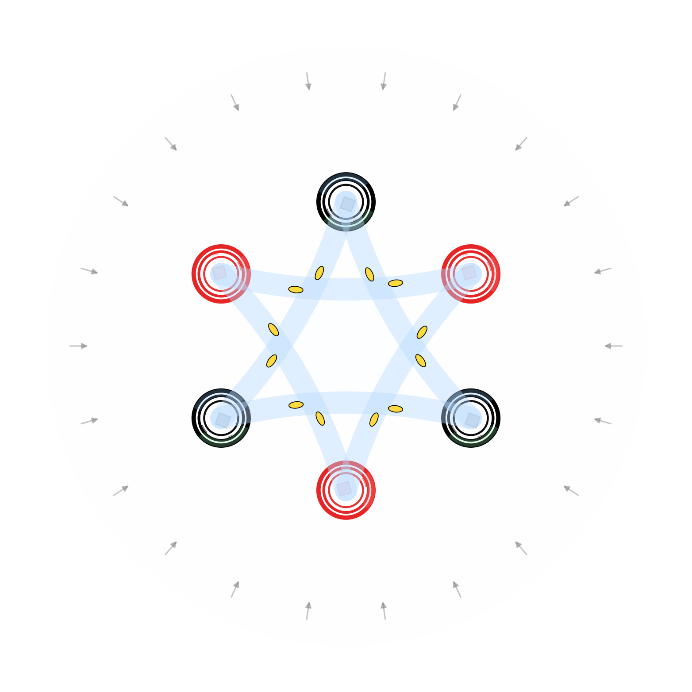
Figure elements (the nuclear structures of different elements differ; the figure uses six small rings as a schematic)
- Nucleon icons
- Thick black multiple concentric rings represent the self-sustaining closed structure of a nucleon. Small inner squares and short arcs indicate phase locking / near-field Texture.
- The two interlaced ring types correspond, respectively, to the proton and the neutron:
- Proton (red in the figure): the near field carries a net outward bias in orientation (intuitively readable as a Texture pattern that is tighter outside and looser inside).
- Neutron (black in the figure): the near-field orientation is organized as a cancellation balance, so the mid- to far-field reading becomes electrically neutral.
- Cross-nuclear corridors (semi-transparent broad-band mesh)
- The broad curved bands connecting neighboring nucleons are the “cross-nuclear corridors.” In EFT they are the near-field settlement channels of the Nuclear Force. They are not newly added independent entities. They are high-Tension passageways formed after nucleon boundaries become shared, extended, and relinked inside the allowed window.
- These corridors are not independent filaments “pulled out” from inside the nucleons. They are the collective response of the Energy Sea to the overlap region of near-field boundaries, connecting neighboring nucleons into a network along the most ledger-economical nuclear-scale paths.
- The corridors together form a triangular-to-honeycomb network, which is one source of intermediate-range attraction, saturation, and the geometry of the valley of stability (because each nucleon can carry only a finite number of connections and a finite angular distribution).
- Yellow small ovals (exchange Wave Packets / gluon appearance): distributed along each corridor, they indicate local exchange / relinking events inside the channel, not long-lived little balls that could be imaged directly.
- Nuclear shallow basin and isotropy (outer arrow ring)
The outer ring made of fine arrows represents the time-averaged isotropic “nuclear shallow basin” (the mass appearance):
- The near field retains directional Texture.
- After the rebound of the Sea smooths the far field, it reads as approximately spherical guidance.
- Pale central core region
The convergence of multiple corridors in the core shows the stiffness of the whole network. It is both one source of shells / magic numbers and a region where collective vibrations (giant resonances) are easily excited.